
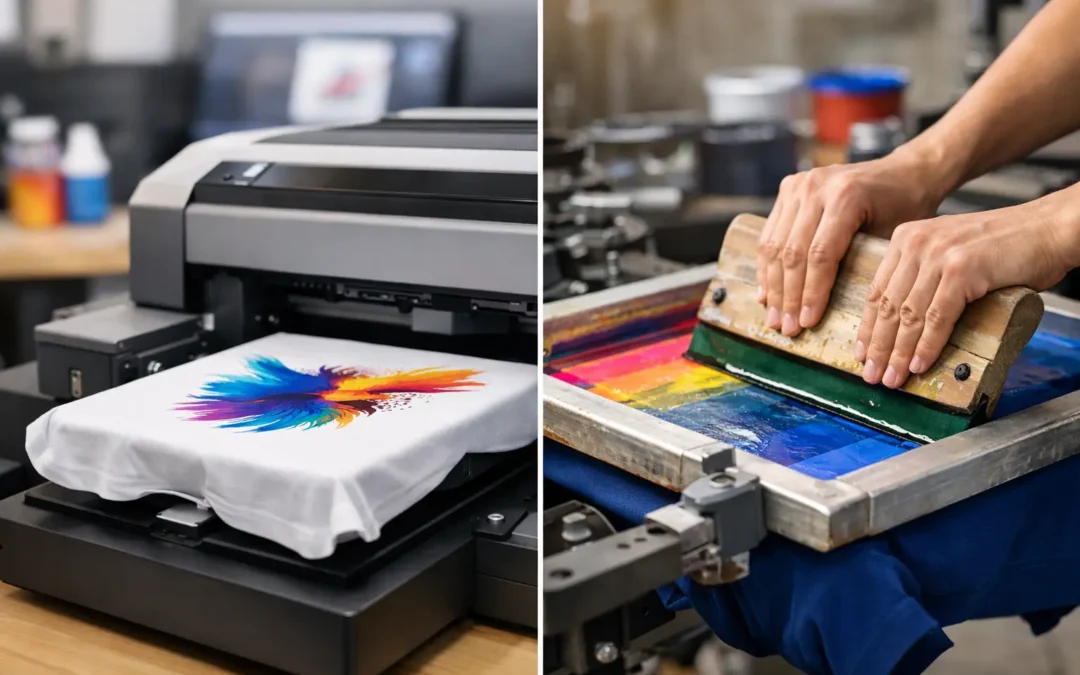
If you are choosing branded uniforms, event shirts, tote bags or promotional merchandise, the decision between digital printing vs screen printing affects more than just appearance. It changes your setup costs, colour accuracy, turnaround time and how well the finished product suits the way your organisation plans to use it.
For buyers ordering for a business, school, club or event, there is no single best method across every job. The right option depends on quantity, artwork, fabric or product type, budget and the standard of finish you need. A small run for a short campaign calls for a different production method than a large order for staff uniforms or merchandise you want to sell.
Digital printing vs screen printing: what is the difference?
Digital printing applies artwork directly onto the product using specialised printers and inks. It is commonly used when the design includes detailed images, gradients, photographic elements or multiple colours. Because the artwork is printed straight from a digital file, setup is generally simpler and faster.
Screen printing works by pushing ink through a mesh screen, with a separate screen prepared for each colour in the design. It is one of the most established decoration methods in the promotional and apparel trade, and it remains a strong choice for bold branding, repeat orders and larger quantities.
At a glance, digital printing usually suits complex artwork and smaller runs, while screen printing often delivers better value and consistency for high-volume orders with simpler designs. That sounds straightforward, but in practice there are a few details worth weighing up before you place an order.
When digital printing makes more sense
Digital printing is often the practical choice when your artwork is visually complex. If your logo treatment includes fine detail, shaded areas, soft transitions or a full-colour illustration, digital production can reproduce that detail more naturally than traditional screen setups.
It is also useful when you do not need a large quantity. Because there is less setup involved, digital printing can be cost-effective for short runs, samples, test campaigns or one-off event merchandise. For a small business trialling a new branded item, or a club ordering limited shirts for a once-a-year function, this matters.
Another advantage is flexibility. If you need variations in artwork, names, numbers or versioned designs, digital methods can often handle that with less production complexity. That can be particularly helpful for schools, sporting groups and event organisers who need customisation across a batch.
The trade-off is that digital printing is not always the best value at higher quantities, and the finish can vary depending on the material being printed. On some garments and products, the print may not have the same bold ink laydown or long-term feel as a well-executed screen print. That does not make it inferior – it simply means the result depends on the item, the artwork and the intended use.
When screen printing is the stronger option
Screen printing continues to be a go-to method for many branded apparel jobs because it is reliable, consistent and economical at scale. Once the screens are prepared, larger runs become more efficient, which helps keep unit pricing under control.
If your logo is clean, bold and made up of solid colours, screen printing can produce an excellent finish. Corporate logos, sponsor marks, school emblems and event branding often suit this method well. The colours tend to look strong and defined, especially on garments where impact from a distance matters.
Durability is another reason buyers choose screen printing. For uniforms, workwear, teamwear or merchandise that will be worn and washed regularly, screen printing often holds up very well when the correct inks and production methods are used. This is especially relevant when consistency across a longer campaign or repeat reorder matters.
The main limitation is setup. Every colour generally needs its own screen, so costs rise when artwork gets more complicated. If you only need a very small run, or your design contains lots of tonal variation, screen printing can become less practical than digital production.
Cost depends on quantity, not just the print method
One of the biggest misunderstandings in digital printing vs screen printing is assuming one method is always cheaper. In reality, cost usually shifts with order size and artwork style.
Digital printing often has the edge on small runs because it avoids the screen setup costs attached to each colour. If you are ordering 10 shirts with a detailed full-colour design, digital may be the more sensible option.
Screen printing often becomes more economical as quantities increase, especially when the artwork uses one to three solid colours. If you are ordering 200 event shirts, staff polos or promotional bags with a clean logo, the setup is spread across the run and the per-unit cost generally comes down.
That is why experienced guidance matters. Looking only at the headline unit price can be misleading if the chosen method is not the best fit for the artwork or quantity.
Colour, detail and print style
Artwork drives the decision more than many buyers expect. A photographic print, intricate illustration or design with gradients is usually better suited to digital printing. A bold logo, block text or simple graphic often suits screen printing.
Colour matching is also worth discussing early. Screen printing can deliver very strong spot colours, which is useful when brand consistency is critical. Digital printing can handle broad colour variation and detail well, but exact reproduction can depend on the substrate and printing system.
For businesses and organisations that care about brand presentation, this is not a minor point. A promotional shirt, bag or stubby holder is part of your public image. If the logo looks dull, too busy or inconsistent with your other materials, the product does not do its job properly.
Fabric and product type matter
Not every decoration method behaves the same way across every product. Cotton tees, performance fabrics, tote bags, aprons and promotional textiles can all respond differently to ink and print application.
Screen printing is widely used across many textile products and remains a dependable option for garments and bags where solid branding is required. Digital printing can perform very well too, but the result depends on the surface, coating and intended finish.
This is where practical production advice makes a difference. A design that looks ideal on screen may need to be adjusted once the actual product is selected. Print size, positioning, ink behaviour and material colour all influence the final result.
Turnaround and production planning
Deadlines have a habit of becoming more urgent once artwork is approved. For event merchandise, school functions, product launches and club apparel, the print method can affect whether a job is realistically achievable within the required timeframe.
Digital printing can be quicker to set up, which is useful when quantities are modest and artwork is ready to go. Screen printing involves more pre-production work, particularly when multiple colours are involved, but it can move efficiently for larger, straightforward runs once setup is complete.
That said, turnaround should never be judged by the print method alone. Stock availability, artwork approval, freight timing and production scheduling all matter just as much. For many buyers, the real benefit comes from working with a supplier who flags issues early and manages the job properly from quote to delivery.
How to choose the right option
If your priority is a short run, full-colour artwork or highly detailed graphics, digital printing is often the better fit. If your priority is strong solid colours, repeat consistency, durability and better value on larger runs, screen printing is usually the smarter choice.
There are also jobs where either method could work, depending on what matters most to you. If budget is tight, the quantity is moderate and the design is fairly simple, a production recommendation should weigh up both options rather than forcing a one-size-fits-all answer.
For Australian businesses, schools, clubs and event organisers, the best outcome usually comes from starting with the product, the artwork and the deadline together. That is how suppliers with practical experience, including ABC2000, help customers avoid costly mismatches between design expectations and production reality.
A good print result is not just about choosing a method. It is about choosing a method that suits the job you actually have, not the one you wish you had on paper. Get that part right, and your branded products work harder for your organisation long after they are delivered.