
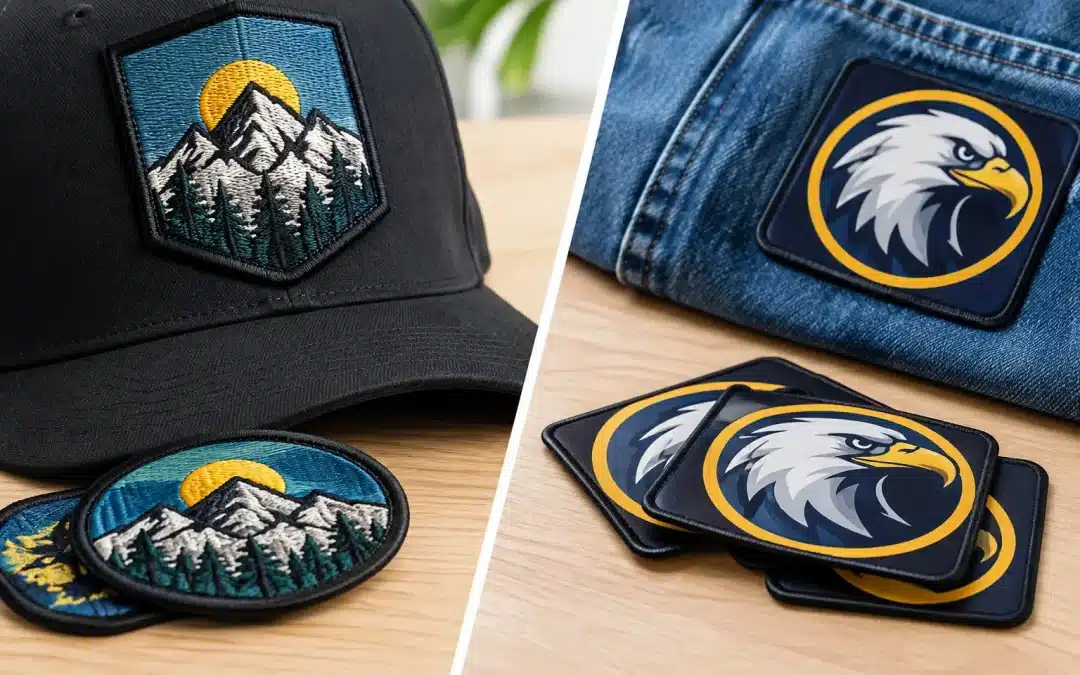
A patch may be small, but it carries a lot of responsibility. On a uniform, cap, jacket or event bag, it needs to present your logo clearly, suit the garment and keep looking professional after regular wear. When choosing woven patches versus printed patches, the better option depends less on personal preference and more on your artwork, application, budget and intended use.
For Australian businesses, schools, clubs and event organisers, the right patch creates a consistent, recognisable finish across team apparel and merchandise. The wrong one can leave fine details unreadable, colours flatter than expected or edges that do not suit the item. Here is how to make a practical choice before production begins.
Woven patches versus printed patches: the key difference
Woven patches are made by weaving fine threads together to form the design. Rather than stitching a design onto a base fabric, the threads themselves create the logo, lettering and detail. The result is a clean, textured patch with a refined, fabric-based appearance.
Printed patches apply the design to a fabric surface, commonly using a full-colour print process. They are especially useful when artwork contains gradients, photographic imagery, intricate colour transitions or very specific brand colours that thread cannot reproduce exactly.
Both can be made with different backing options, including sew-on, iron-on, hook-and-loop fastening or adhesive backing. The backing changes how the patch is applied, but it does not change whether woven or printed is the better visual choice.
When woven patches are the stronger option
Woven patches are a dependable choice for logos with fine lines, small lettering and detailed but solid-colour artwork. The fine threads can produce sharper detail than traditional embroidery, particularly when a badge needs to include a club name, service title or compact logo element.
They also offer a neat, professional finish that works well on corporate uniforms, school apparel, sporting club garments, scout-style badges and retail merchandise. Because the surface is woven rather than heavily raised, the patch generally sits flatter than an embroidered badge. This can be more comfortable on shirts, caps and lighter garments.
A woven finish suits designs with defined colour areas. Think clean logos, badges, symbols and text that need an established, premium look. The texture adds a sense of quality without overwhelming the design.
There are limits. Woven patches use thread colours, so they are not ideal for photographic designs or soft tonal gradients. Very small areas of text may also need to be simplified, particularly if the finished patch itself is small. A good supplier will review the artwork and recommend a workable size before production, rather than simply sending a difficult design to print.
Woven patches are often best for
Woven patches are commonly selected for staff uniforms, association badges, school and club identity, branded caps, workwear and commemorative patches. They are particularly effective where the artwork is clean and the goal is a traditional fabric badge that will look at home on a garment for years.
When printed patches make more sense
Printed patches excel where colour accuracy and visual detail matter most. If your logo uses gradients, multiple shades, watercolour effects, metallic-looking artwork or photographic elements, printing is usually the more faithful method. It can reproduce much more visual information than a thread-based process.
They are also a smart option for event merchandise and promotional campaigns with bold, colourful artwork. A music festival design, a full-colour mascot, a charity campaign image or a product illustration can retain its intended look without being reduced to a limited thread palette.
Printed patches can be an efficient solution for designs with many colours, because the production cost is not driven by adding extra thread colours in the same way as woven or embroidered options. That does not automatically make them the cheapest choice on every order, but it can improve value for detailed artwork.
The trade-off is finish. A printed patch has a smoother, more graphic appearance and less of the tactile character associated with woven fabric. For some corporate uniforms or heritage-style club badges, that can feel less traditional. It is also worth considering how the print will be exposed to abrasion, washing and sunlight in its intended setting.
Printed patches are often best for
Printed patches suit full-colour promotional merchandise, event apparel, fashion designs, image-heavy artwork and logos where an exact colour blend is essential. They are also useful when the design needs to match existing printed marketing materials closely, such as banners, brochures or branded displays.
Detail, texture and colour: what your logo needs
The artwork should lead the decision. A simple logo with solid colours and fine type is usually well suited to weaving. A design with a sunset gradient, complex illustration or dozens of colour variations is usually better printed.
Do not assume a patch will look exactly like a logo displayed on a screen. Screens use light to produce colour, while woven patches use physical thread and printed patches use ink on fabric. Pantone references, high-resolution artwork and a clear understanding of the finished size all help achieve a closer result.
Texture is equally important. Woven patches have visible thread structure and a fabric feel, which can add depth to a logo. Printed patches provide a flatter result that keeps the artwork front and centre. Neither is inherently better. The question is whether your brand should feel crafted and traditional, or crisp and graphic.
Durability depends on use, not just the patch type
It is tempting to treat woven patches as durable and printed patches as less durable, but the real answer is more considered. A well-made patch with the right backing, border and attachment method can perform very well. The demands of the garment matter most.
For workwear that is washed regularly, a sewn application is generally the most secure option. For tactical gear, sports uniforms or garments where badges need to be swapped, hook-and-loop backing can be practical. Iron-on backing may suit promotional apparel and lighter-duty uses, provided the garment fabric and care instructions are appropriate.
A border can also affect longevity and appearance. Merrowed borders provide a traditional raised edge and work well on regular patch shapes. Laser-cut or heat-cut edges are often better for custom shapes and fine outlines. The right finish prevents fraying and gives the patch a more deliberate final presentation.
Before ordering, consider where the patch will sit. A sleeve, chest or cap front has different wear conditions from a bag, jacket back or event giveaway. If garments will face industrial washing, outdoor use or frequent friction, raise that requirement early in the quoting process.
Cost, quantities and lead times
Patch pricing is affected by size, shape, backing, border, artwork complexity, quantity and production method. A larger patch uses more material and requires more production time. Custom shapes and specialised fastening options can also add cost.
The best value usually comes from choosing a patch style that suits the artwork from the start. Trying to force a detailed printed design into a woven format may require simplification and extra artwork work. Choosing print for a simple two-colour uniform badge may save little while missing the textured look the organisation wanted.
Lead times should be discussed before an event date, uniform rollout or campaign launch is locked in. Production schedules can vary with quantities, artwork approvals and finishing requirements. Allowing time for a digital proof and any required adjustments protects both brand quality and your delivery deadline.
Avoid the common patch ordering mistakes
The most common issue is ordering a patch that is too small for the logo detail. Small text, web addresses and fine lines may need to be removed, enlarged or reworked. A patch should be designed to be read at the distance it will normally be viewed, not at 400 per cent magnification on a computer monitor.
Another mistake is overlooking the garment. Dark fabric may need a border or a contrasting edge. Stretch garments need an application method that will not affect comfort or movement. A cap may need a patch shape and backing that conforms neatly to its curved front panel.
Finally, do not treat the patch as an isolated item. It should work with your other branded materials, from lanyards and lapel pins to banners, drinkware and event signage. Consistent colours, logo proportions and messaging make a stronger impression than any single product can achieve alone.
Choosing the right patch for your organisation
Choose woven patches when you want a polished fabric badge for clean logos, fine lettering and uniform-ready branding. Choose printed patches when the artwork relies on full colour, gradients, images or precise visual effects. If your design falls between the two, the intended garment and desired finish will usually make the answer clear.
For projects involving uniforms, club apparel, recognition programs or event merchandise, it pays to share the artwork, quantity, garment type and required date before committing to a production method. ABC2000 can help assess the practical details, from patch size and border style to the finish that best represents your organisation.
The strongest patch is not simply the one that looks best in a proof. It is the one that still represents your brand well after the event is over, the uniforms are in regular rotation and your team is out in the community.