A busy trade show, school fete or club presentation gives people only seconds to understand who you are. Marketing displays do the hard work before a conversation begins. A clear banner, branded table display or well-placed sign makes your organisation easier to find, more professional to approach and more memorable after the event.
For Australian businesses, clubs, schools and event organisers, the right display is not simply a large logo. It is a practical part of your brand image. It needs to suit the space, carry the right message, travel well and arrive in time. Getting those details right can make a modest stand look organised and credible, while getting them wrong can leave a good brand hard to see.
Start with the job your marketing displays need to do
The best display format depends on where it will be used and what you need people to do next. A display designed to attract foot traffic at an outdoor event has different requirements from one used behind a reception counter or at a sponsor presentation.
If the aim is simple brand awareness, a strong logo, distinctive colours and a short line of supporting text may be enough. For a sale, enrolment drive, fundraising event or product launch, the display may need one clear call to action, such as a website address, QR code, event date or offer. Trying to fit every service, phone number and social handle onto one banner usually makes it harder to read.
Consider the viewing distance first. People several metres away should be able to recognise your name and main message immediately. Those standing close can then see supporting details. This simple hierarchy is one of the most useful rules in display design.
Think about the setting, not just the product
Indoor displays benefit from controlled lighting and protection from weather, so presentation and detail can take priority. Reception areas, retail counters, offices and conference venues are suitable for branded signage, pull-up banners and table displays that reinforce a polished, consistent identity.
Outdoor settings bring more variables. Wind, uneven ground, rain, sun glare and crowd movement all affect performance. A display that looks excellent in a showroom may not be the best option beside a sports field or on a windy community event site. In these cases, stability, readable graphics and durable materials matter as much as visual impact.
Also consider how often the display will be moved. A one-off launch may justify a specialised format, while a business attending regular expos needs equipment that packs down efficiently, stores safely and can be set up by staff without fuss.
Popular marketing display options and where they work
Banners remain a practical choice because they create immediate scale without taking up much floor space. Pull-up banners are well suited to exhibitions, presentations, showrooms and information days. They are portable, quick to position and easy to reuse when the message is not date-specific.
Vinyl banners work well where a larger message is needed across a fence, wall, stall frontage or event entrance. They can be particularly effective for sporting clubs, school events, community groups and outdoor promotions. The key is to allow enough space around the logo and keep wording bold.
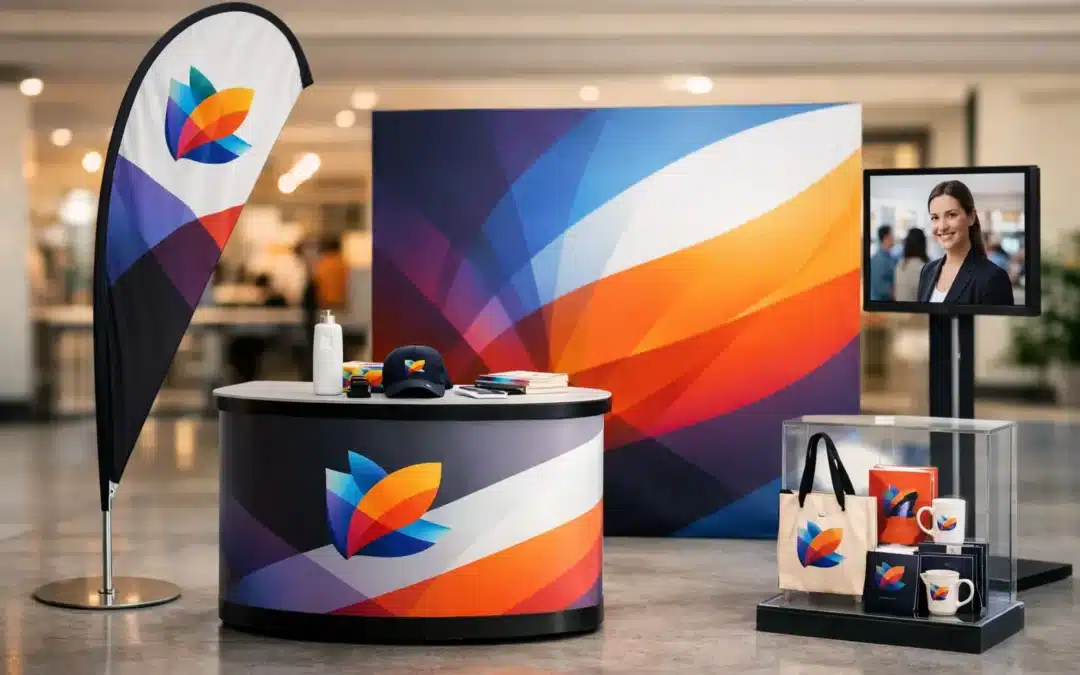
Branded tablecloths and counter displays help turn a standard trestle table into a recognisable information point. They are useful at fundraising stalls, product demonstrations, registration desks and trade events, where visitors need to know where to ask questions or collect materials.
Flags, balloons and other high-visibility event items can help draw attention from a distance, especially in open spaces. They work best as part of a coordinated display rather than as the only branded element. A flag may help people locate your site, while a banner or table display explains what you offer once they arrive.
There is no single best option. A local café promoting a new menu may only need a counter sign and window display. A construction business at an industry expo may need a larger backdrop, banners and branded giveaways. A club hosting an awards night may focus on presentation signage and sponsor recognition. The right selection follows the purpose and location.
Keep the artwork clear, consistent and production-ready
Good artwork is one of the biggest differences between a display that looks professional and one that looks improvised. A logo copied from a website or supplied as a small screenshot can appear soft or pixelated once enlarged. Wherever possible, provide a high-resolution vector logo file. This helps maintain sharp edges and accurate branding across larger formats.
Colour matching needs attention as well. Brand colours can appear different on screens, paper, fabric and display materials. If your organisation has established colour specifications, provide them at the start. This reduces guesswork and helps maintain consistency across banners, printed business cards, apparel and promotional merchandise.
Use high contrast between text and background. Dark lettering on a light background, or light lettering on a dark background, is generally easier to read than colours with similar tones. Fine fonts, long sentences and busy photographs may look appealing on a computer but lose impact at event distance.
A practical layout usually gives priority to three elements: your logo, the main message and a way to take the next step. That next step could be visiting your website, calling your team, scanning a QR code or speaking to staff at the stand. Leave room for these elements to breathe. Empty space is not wasted space when it makes the message easier to absorb.
Match your budget to the expected use
Price matters, particularly for volunteer-run organisations, smaller businesses and events with several competing costs. The lowest upfront price is not always the best value if the display is likely to be used repeatedly. A durable, well-finished banner with reliable hardware may cost more initially but can support months or years of promotions.
On the other hand, a short campaign with changing dates, prices or sponsors may call for a more economical solution. It makes little sense to invest heavily in a display that becomes outdated after one weekend. In that situation, keep the permanent branding on reusable materials and put changeable information on separate printed inserts or signs.
It is also worth looking beyond the display itself. Freight, setup accessories, carry bags, replacement graphics and production time can affect the final value. Ask early what is included, how the item is packed and whether artwork assistance is available. Clear advice at the quotation stage helps avoid surprises later.
Plan early for better results and fewer compromises
Display projects are often delayed because the event date is fixed but the artwork, approvals or quantity decisions are not. Starting early gives you more choice of formats and materials, more time to check artwork, and less pressure when changes are needed.
Before requesting a quote, have the essential details ready: the intended use, display size or available space, quantity, deadline, logo files and any brand guidelines. If the display is for an event, include whether it will be used indoors or outdoors and whether staff need to transport it themselves. These details make it easier to recommend a suitable product instead of offering a generic option.
Allow time for proofing. A proof is your opportunity to check spelling, phone numbers, colours, logo placement and sizing before production begins. Ask more than one person to review it, particularly when dates, sponsor names or legal wording are involved. A final check takes minutes. Reprinting a large display takes longer and costs more.
Build a display system, not a one-off item
The strongest brand presence comes from displays that work alongside the rest of your promotional material. A banner with the same colours and message as your brochures, pens, lanyards, uniforms and business cards creates a more considered impression. People may not consciously notice every match, but they recognise the consistency.
This does not mean every item must carry identical artwork. Your main display should communicate the broadest message, while smaller products can support it with a logo, contact details or campaign theme. A business can use one core visual style across multiple materials while adapting the wording to each purpose.
For organisations that attend regular events, it can be useful to create a small display kit. A reusable banner, branded table covering, name badges, printed information and a few practical giveaways can be packed and ready for the next opportunity. This makes event preparation easier and helps staff present the organisation consistently, even when different people attend.
A well-chosen display gives your team a visible home at any event or customer-facing space. When it is designed for the setting, produced with care and supported by clear artwork, it continues working long after it has been set up. ABC2000 can help bring those moving parts together, so your next display looks right, arrives when needed and represents your organisation with confidence.