
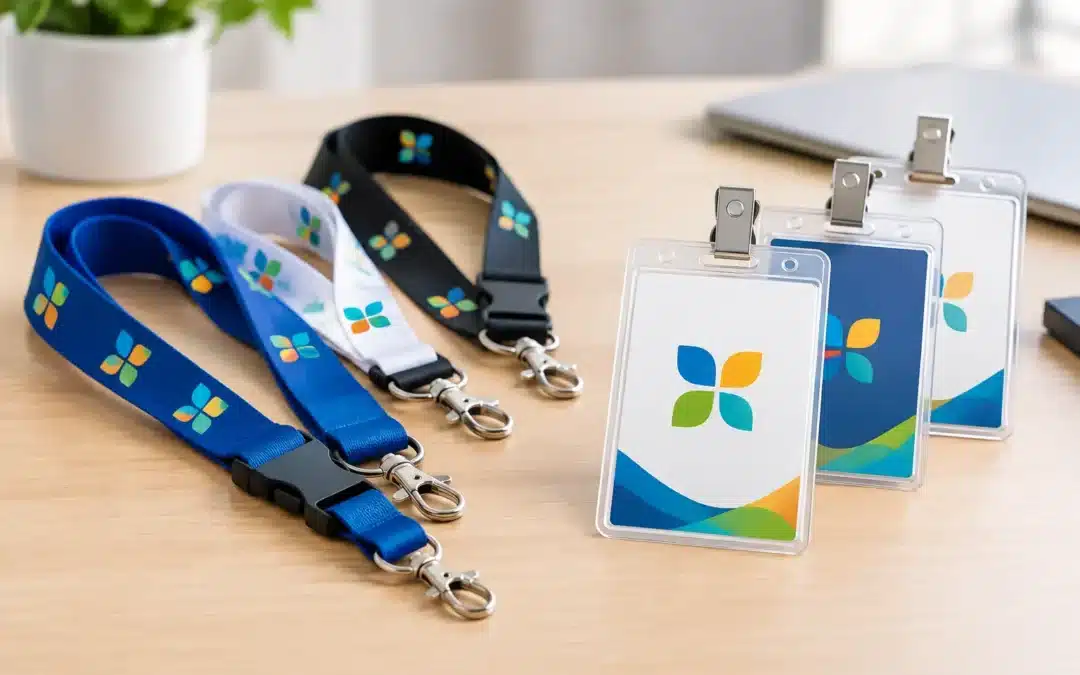
A delegate walks into a busy conference foyer, a new employee starts their first shift, or a volunteer greets visitors at the school gate. In each case, people need to know who is who quickly. The lanyards vs name badges decision affects more than appearance – it shapes recognition, security, comfort and how consistently your organisation presents its brand.
For many Australian businesses, clubs and event organisers, the best answer is not automatically one or the other. Lanyards and name badges solve different identification problems. Choosing well starts with understanding where they will be worn, what information must be visible, and how often they will be used.
Lanyards vs name badges: the practical difference
A lanyard is a neck strap, usually fitted with a clip, hook or breakaway attachment to hold an ID card, access pass, keys or event credential. It is highly visible from a distance and gives your logo room to be repeated along the strap. It also makes a pass easy to carry throughout a busy day.
A name badge is attached directly to clothing, commonly with a magnetic backing, pin, clip or combination fitting. It normally displays a person’s name, role and organisation. Name badges look more formal and are especially useful when personal interaction matters, such as retail, hospitality, healthcare, customer service and professional appointments.
The distinction becomes clearer when you consider the information each product carries. A lanyard identifies the organisation first, while the card or credential on it may identify the individual. A name badge puts the individual first, with the business identity supporting them. That difference matters in customer-facing environments.
When branded lanyards are the stronger choice
Lanyards are built for movement, access and high-volume identification. They suit conferences, trade shows, festivals, sporting events, school excursions, workplace induction days and sites where staff need swipe cards or keys close at hand.
They are also effective promotional products. A custom lanyard can carry your logo, website, event name, sponsor message or colours along its length. In a crowd, consistent lanyards make staff, volunteers and accredited guests easier to spot. For large events, colour-coded lanyards can separate exhibitors, speakers, crew, VIPs and general attendees without requiring people to read small print.
There are practical choices to make before ordering. Polyester lanyards are a popular, cost-effective option for large quantities. Woven lanyards offer a textured, durable finish, while dye-sublimated lanyards allow more detailed full-colour artwork. If the lanyard will be used in a workplace, a safety breakaway is often worth considering. It releases under pressure and is particularly relevant around machinery, children or active work areas.
The main limitation is that a lanyard does not always provide the immediate personal introduction that a name badge does. An ID card can swing, flip around or sit below eye level. If your staff spend most of their day speaking one-to-one with customers, a lanyard alone may not be enough.
When name badges make better sense
Name badges create a more personal, professional first impression. A customer can see the name of the person helping them without needing to ask. That small detail can make service feel more accountable and approachable, whether at a café counter, showroom, reception desk, medical practice or community event.
They are particularly effective for permanent teams. A well-made badge with a clear logo, readable name and job title can become part of the standard uniform, helping every location or shift present the same polished image. For businesses that rely on repeat customers, badges can support familiarity as well as brand recognition.
Magnetic name badges are often the preferred choice for uniforms and business clothing because they avoid pinholes. Pin fittings can be suitable for occasional use and are generally more economical, but they may damage delicate fabrics. Clip-on options offer flexibility for temporary staff, although they need to be positioned carefully so they remain visible.
Size and layout deserve proper attention. A badge should be readable at normal conversation distance, not crowded with every possible detail. In most cases, the logo, first name and role are enough. Long names, small type and low-contrast colours can make even a premium badge less useful.
Visibility, security and comfort
The right choice often comes down to which requirement carries the most weight. If security and controlled access are the priority, lanyards with ID cards are usually the practical option. Cards can include a photo, barcode, QR code, access technology or event-specific details. They are easy to issue, collect and replace.
If face-to-face interaction is the priority, name badges generally win. They sit higher on the chest, remain steady while the wearer moves and let customers identify a staff member quickly. This is valuable in settings where people may not know who to approach for help.
Comfort matters too. A lanyard can become inconvenient for staff doing physical work, leaning over benches or wearing layered uniforms. A badge may be a better everyday solution in these settings. On the other hand, a name badge cannot carry keys, swipe cards or accreditation passes, so it cannot replace a lanyard where access is essential.
For some organisations, combining both is the most effective approach. Staff may wear a name badge for customer service and a branded lanyard for an access card. This works well in larger offices, hospitals, venues and exhibitions, provided the branding is coordinated rather than competing.
Budget and ordering considerations
The cheapest unit price is not always the lowest overall cost. Reusable lanyards can be a sensible investment for regular staff or annual events, while event-specific printed lanyards can become a useful keepsake and sponsor asset. For a one-day function, a simple lanyard and printed credential may be more economical than individual permanent badges.
Name badges tend to suit smaller, stable teams where each person needs a personalised item. If employee turnover is high, consider how easily names can be updated and whether generic role badges would be useful for casual staff. Keep a small allowance for replacements, new starters and last-minute event changes.
Artwork quality is equally important. Your logo needs to reproduce clearly at the chosen size, and brand colours should be selected with the printing method in mind. Fine details that look sharp on a business card may not translate well onto a narrow lanyard or compact badge. Supplying clean logo files and confirming the final artwork before production helps avoid costly surprises.
Allow enough lead time for artwork approval, personalisation and delivery, particularly before conferences, end-of-year functions or major community events. Quantities, fitting types, individual names and packaging requirements should be settled early. A production partner that checks these details can save a great deal of pressure close to deadline.
A quick way to make the decision
Choose lanyards when people need to carry credentials, when you are managing a crowd, or when prominent event branding matters most. Choose name badges when staff are regularly meeting customers and need to be personally identifiable. Use both when access control and approachable service are equally important.
Before placing an order, ask four practical questions: Who will wear the item? What must it hold or display? How long will it be used? What should people notice first – the organisation, the event or the person? Clear answers will narrow the product choice quickly.
ABC2000 can help organisations match lanyard materials, badge styles, fittings and artwork to the way their teams actually work. The most effective identification products are not simply branded merchandise. They are practical tools that make people easier to recognise, better prepared to help and more confident representing your organisation.