A branded giveaway that breaks after one use, or ends up in the rubbish before an event is over, does very little for a business or club. The strongest sustainable promotional products trends are not about adding a green label to ordinary merchandise. They are about choosing useful items, understanding what they are made from and ordering with enough care that products are genuinely kept.
For Australian organisations, sustainability also needs to work in the real world. A school fundraiser has a budget. A conference has a delivery date. A sporting club needs products that survive regular use. The right choice balances environmental considerations with quality, branding, quantity and the practical purpose of the promotion.
Sustainable promotional products trends buyers should know
Useful products are replacing novelty giveaways
The most meaningful shift is towards products with a clear job to do. Reusable drinkware, quality notebooks, tote bags, lanyards, pens and workwear accessories remain popular because they can become part of a person’s routine. The longer an item stays in use, the more opportunities it has to display your logo.
This does not mean every campaign needs the same reusable bottle or bag. The best product depends on the recipient and setting. A branded stubby holder may be highly relevant for a community event, while a recycled notebook and pen set may suit a professional seminar. Relevance is a sustainability decision as much as a marketing decision, because unwanted products are the ones most likely to be discarded.
Recycled and renewable materials are becoming more specific
Buyers are asking better questions about materials. Rather than simply requesting an “eco-friendly” item, they want to know whether a product contains recycled plastic, recycled paper, cork, bamboo, wheat straw or organic cotton, and how that material affects durability and appearance.
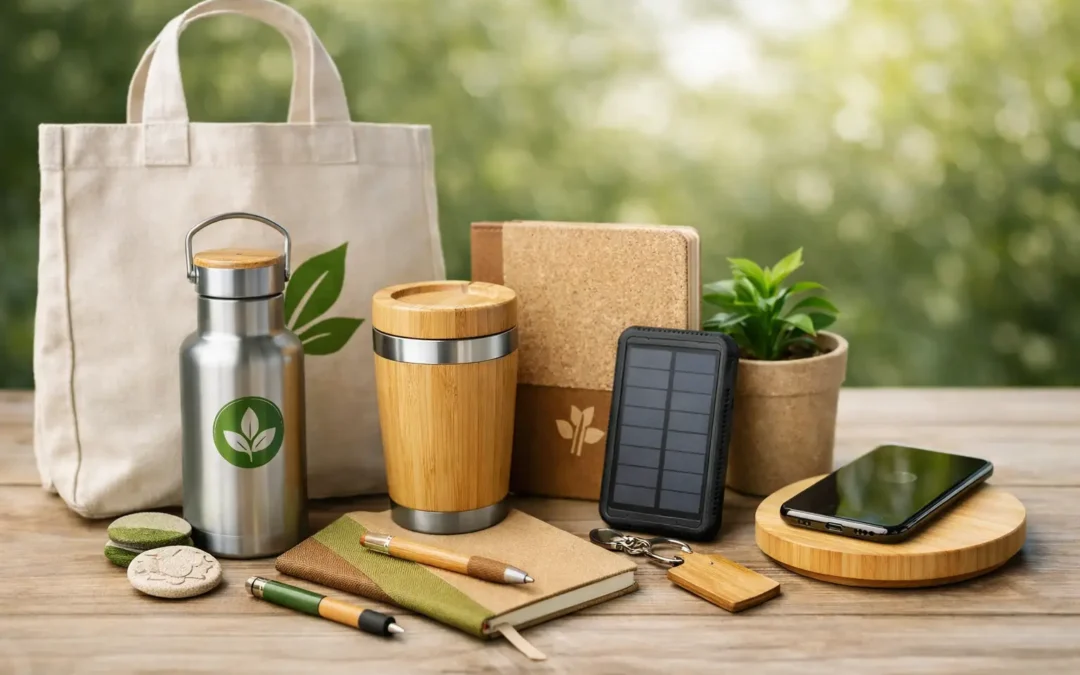
Recycled PET, often made from post-consumer plastic bottles, is now commonly used in bags, lanyards and apparel-style accessories. Recycled paper is a practical option for notebooks, packaging and desk items. Cork and bamboo can provide a natural finish for selected drinkware, coasters, stationery and technology accessories.
Material claims need to be handled carefully. Bamboo, for example, may be a renewable material, but it is not automatically the right choice for every product or brand. It can vary in grain and colour, and may suit laser engraving better than detailed full-colour artwork. Recycled materials can also show natural flecks, texture or minor variation. For many brands that is part of the appeal, but it should be approved before production.
Fewer, better items are carrying more brand value
Ordering the lowest-cost item in the highest possible quantity is no longer the default approach. Many organisations are choosing a smaller number of better-quality products for customers, staff, speakers, volunteers or key event attendees.
A well-made insulated tumbler, durable umbrella, premium cap or useful desk accessory may cost more per unit than a throwaway giveaway. However, it can create a stronger impression and remain visible for years. This approach is particularly effective for staff recognition, client gifts, membership milestones and events where the audience is clearly defined.
There is still a place for cost-effective high-volume merchandise. Pens, badges and balloons can be appropriate for open days, campaigns and family events. The key is to match the quantity and product type to likely demand, rather than over-ordering simply because the unit price falls at a higher volume.
Packaging and presentation are under closer scrutiny
Sustainable product selection can be undermined by excessive individual packaging. More buyers are requesting simpler packaging, reduced plastic components and consolidated freight cartons where suitable. For events, products can often be packed by team, location or registration group to make distribution easier and reduce unnecessary handling.
Presentation still matters. A client gift or award item may require a gift box or protective packaging, particularly if it is fragile or premium. The practical question is whether the packaging protects the product, supports the occasion and can be recycled or reused, rather than existing only for show.
Local coordination matters as much as product origin
Not every promotional item can be made in Australia, and global supply chains remain part of the industry. However, organisations are placing greater value on accurate production planning, dependable communication and avoiding waste caused by rushed mistakes, incorrect artwork or late changes.
A product that has to be remade because the logo is distorted, the colour is wrong or the deadline was missed carries an environmental cost as well as a financial one. Supplying clear artwork, confirming quantities early and approving a proof carefully can prevent that waste. It also gives more time to source the best available option instead of settling for whatever can arrive fastest.
How to choose sustainable merchandise without compromising your campaign
Start with the moment the recipient will use the product. Consider where they will be, what they are likely to carry and whether the item solves a small, everyday need. A commuter may value a coffee cup. A volunteer team may need caps, lanyards or drink bottles. A trade show visitor may prefer a compact tote that helps carry catalogues and samples.
Then look at product life. Ask whether the item is likely to be used once, occasionally or every week. A simple product with a long useful life is often a more sensible choice than a complicated item with a fashionable material claim. Quality printing also matters here. If branding peels, fades or cracks quickly, the product loses its purpose even if the base material is recycled.
Artwork should suit the item and decoration method. Screen printing can deliver clear, bold branding on bags and apparel. Pad printing is commonly used for shaped items such as pens and drinkware. Laser engraving can create a permanent finish on selected metal, bamboo and cork products. A supplier should explain where fine detail, gradients or exact PMS colour matching may be limited, rather than promising a result that the product cannot achieve.
Finally, consider the whole order. Can one product range cover staff, customers and event guests without creating confusion? Can you reduce the number of separate deliveries? Is the chosen quantity realistic? These operational details may not sound glamorous, but they make a material difference to cost control and waste reduction.
Categories leading the shift
Drinkware remains a strong choice because it has obvious repeat use. Reusable bottles, travel mugs, tumblers and aluminium cups can suit workplaces, outdoor events, clubs and customer gifts. The best option depends on whether portability, insulation, dishwasher suitability or premium presentation is the priority.
Stationery is also evolving beyond disposable basics. Recycled-paper notebooks, pens using recycled content and cork-covered journals work well for training sessions, conferences and office welcome packs. They are easy to brand and straightforward to distribute, particularly when paired as a practical set.
Bags and carry items continue to offer broad visibility. Recycled PET tote bags, cotton bags and drawstring packs can be useful at exhibitions, schools and retail promotions. Bag quality is worth assessing closely: handle construction, fabric weight and print area all affect whether the item will be used repeatedly.
For clubs and community organisations, apparel and event merchandise can be an effective long-term choice. Beanies, scarves, caps, patches and badges build identity while giving members something they genuinely want to wear or collect. In these cases, a timeless design and quality finish will usually outlast a trend-led graphic.
Avoid green claims that cannot be explained
Terms such as “eco”, “green” and “earth-friendly” are easy to use and hard to measure. Organisations should be able to explain, in plain language, why they selected a product. Perhaps it contains recycled material, replaces a disposable item, uses less packaging or has been chosen for its long useful life.
It is also wise to avoid overstating the benefit in campaign messaging. No physical promotional product has zero impact. Honest communication builds more trust than broad environmental claims that cannot be supported. If the material composition or certification matters to your organisation, request the available product information before approving the order.
ABC2000 can help narrow a wide product range into options that suit your budget, artwork, audience and delivery date, while keeping the sustainability conversation practical.
The best sustainable promotional product is rarely the one with the loudest claim. It is the item people choose to keep, use and see again long after the event, meeting or campaign has finished.