A charity sausage sizzle, fun run or community fundraiser has a short window to make an impression. Supporters need to find the right stall, volunteers need to look organised, and donors need a clear reminder of the cause they have backed. Well-chosen branded merchandise does all three. The best promotional products for charities are useful, affordable at the required quantity and closely connected to the event or organisation’s purpose.
For Australian charities, clubs and volunteer-led groups, the right product is rarely the most expensive one. It is the item people will actually keep, wear or use after the event, while displaying your logo, message or campaign colours clearly. Planning the product around your audience, budget and deadline is what turns a giveaway into practical fundraising and long-term recognition.
What makes a charity promotional product worth buying?
A product should earn its place in the budget. Before selecting colours or artwork, consider who will receive it and what action you want them to take. A thank-you item for regular donors has a different job from merchandise sold at a school fete. Likewise, a high-visibility item for volunteers is different from a low-cost handout for a public awareness campaign.
Practicality matters because branded items are seen more often when they become part of someone’s routine. A reusable drink bottle, pen or tote bag can continue representing your organisation long after a one-day event has finished. For a fundraising campaign, perceived value matters too: supporters are more willing to purchase an item that feels useful and well made.
Branding needs to suit the product. Fine detail can look excellent on a printed banner or a badge, but may be too small for a keyring. A strong logo, campaign name and one readable message usually work better than trying to fit every contact detail onto a compact item. Colour matching, print method and available branding area should be checked before production begins.
Best promotional products for charities and fundraisers
1. Branded tote bags
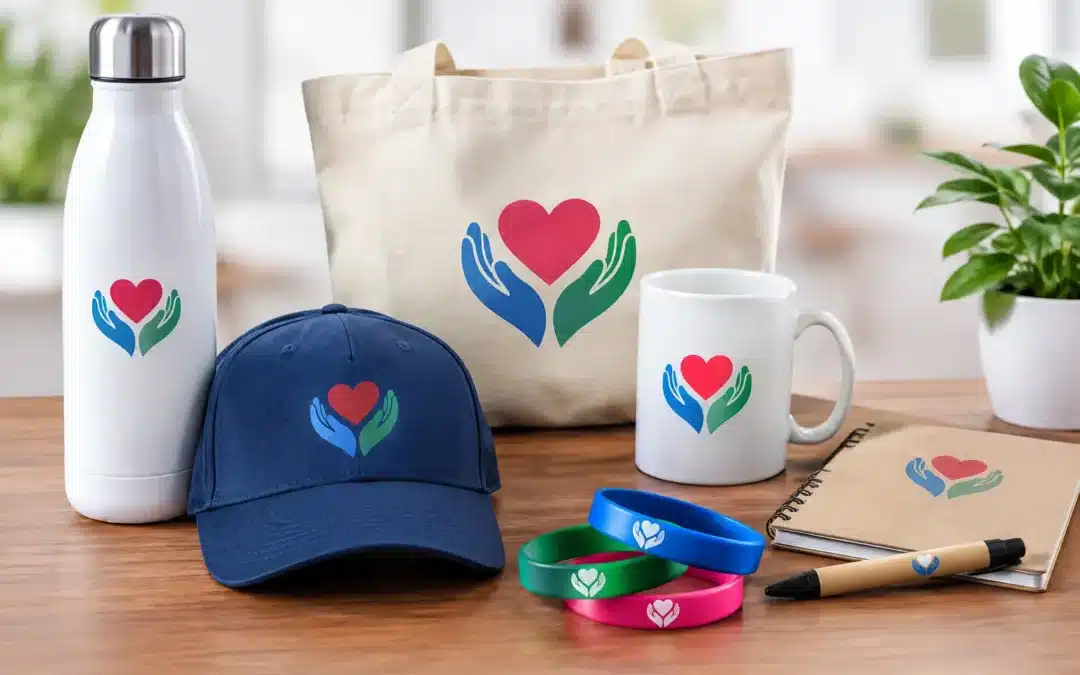
Tote bags are a reliable choice for charity shops, conferences, market stalls and community events. They offer generous print space for a logo or campaign artwork, are easy for supporters to carry, and can be sold as merchandise or included with registrations and donor packs.
They are particularly effective where your audience is likely to use them at markets, libraries, schools or around the local shopping strip. Choose a bag quality that suits its purpose. A lightweight option may work for a large awareness giveaway, while a heavier reusable bag makes more sense as a retail fundraising item.
2. Reusable drink bottles and keep cups
Drinkware is practical, visible and well suited to charity walks, sporting events, staff wellbeing programs and volunteer recognition. Supporters can use a branded bottle on the day, then take it to work, training or school. Keep cups can be a strong option for corporate fundraising partnerships or donor gifts.
The trade-off is budget. Drinkware generally costs more than pens or wristbands, so it is best used when the audience is likely to value and keep it. It can also work well as part of a higher registration tier or a fundraising pack rather than a mass handout.
3. Promotional pens and notebooks
Pens remain one of the most cost-effective ways to put a charity name into regular use. They are suitable for information stalls, reception areas, community meetings, training sessions and mail-outs. Pairing a pen with a notebook creates a more substantial donor or attendee gift without making the order difficult to manage.
For charities operating on tight budgets, this combination offers dependable value. A pen is simple, but it can be highly effective when the logo is clear and the writing quality is good. Cheap items that fail quickly can reflect poorly on the organisation, so quality should still be part of the decision.
4. Event T-shirts, caps and beanies
Wearable merchandise creates instant team identity. Matching T-shirts help volunteers stand out at a fun run, collection drive or festival, while caps and beanies are useful for outdoor events in Australian weather. They also give supporters a visible way to show affiliation with the cause.
Apparel requires more planning than a simple giveaway. You will need to consider sizing, garment colours, decoration method and lead time. A limited range of unisex sizes can simplify a volunteer order, while pre-orders may reduce risk for charity merchandise intended for sale. If your event is in winter, beanies can offer more relevance than a standard T-shirt.
5. Lanyards, name badges and lapel pins
For conferences, gala dinners, exhibitions and formal community events, identification products bring order as well as brand presence. Branded lanyards and name badges help attendees identify organisers, speakers and volunteers quickly. They are especially useful where visitor safety, access or networking is part of the event.
Lapel pins offer a more lasting recognition item. They suit board members, long-serving volunteers, sponsors and major supporters, and can be designed to mark an anniversary or campaign milestone. Because pins feel more commemorative, they are generally better for selected recipients than broad distribution.
6. Keyrings, wristbands and badges
Small promotional products are ideal where quantity matters. Keyrings, wristbands and badges can carry a simple message at a low entry cost, making them suitable for school fundraisers, awareness weeks, donation tins and community stalls. They are easy to distribute and easy for supporters to purchase on impulse.
These items work best with straightforward branding. A campaign colour, short phrase or recognisable symbol is often more effective than a detailed logo treatment. They can also be used to identify paid participants, volunteers or supporters at an event.
7. Stubby holders and outdoor event items
For relaxed community fundraisers, sporting clubs and local events, stubby holders can be a popular merchandise choice. They are useful, easy to store and offer a broad printable area. In the right setting, they become an item people keep in the caravan, shed or outdoor entertaining area.
Context is key. A stubby holder may be a natural fit for a regional sports fundraiser, but less appropriate for a health service or family-focused campaign. The product should always support the organisation’s values and audience expectations.
Match the product to the fundraising objective
The smartest order begins with the campaign goal, not the catalogue. If the priority is public awareness, choose an inexpensive item that can reach many people, such as pens, badges or wristbands. If the goal is revenue, select merchandise with a stronger perceived value, such as tote bags, drinkware or apparel. For volunteer visibility, practical uniforms, lanyards and name badges are usually the better investment.
A donor thank-you program calls for a more personal approach. A quality notebook, engraved pen, lapel pin or commemorative item can acknowledge loyalty without appearing excessive. For milestone appeals, specialist pieces such as commemorative teaspoons or aluminium coasters can also provide a distinctive keepsake when they fit the organisation’s story.
It is worth considering whether one product can perform two jobs. A branded tote bag may hold participant materials on event day, then become a useful everyday item. A drink bottle may support a fun run while providing ongoing campaign visibility. This is often better value than ordering several unrelated giveaways.
Get the artwork, quantities and timing right
A good product can still disappoint if the artwork is rushed or the delivery date is missed. Supply your logo in the best available format and be clear about brand colours, wording and the required print area. If your charity uses partner logos or sponsor recognition, decide early how these will be arranged. Crowded artwork is harder to read and may require a larger product or different decoration method.
Quantities should reflect expected attendance, plus a sensible allowance for volunteers, speakers and unexpected demand. Ordering too few can be frustrating at a busy event, but over-ordering niche dated merchandise can tie up funds and storage space. For recurring events, products without a year or event date are often easier to use again.
Allow time for artwork approval, production and freight, particularly before major fundraising seasons or large Melbourne events. ABC2000 can help coordinate product selection, branding and production details so your team can focus on supporters rather than chasing multiple suppliers.
The most effective charity merchandise feels considered rather than promotional for its own sake. Choose an item your supporters will genuinely use, give the design room to be seen, and place the order early enough for every volunteer and donor to receive it with confidence.